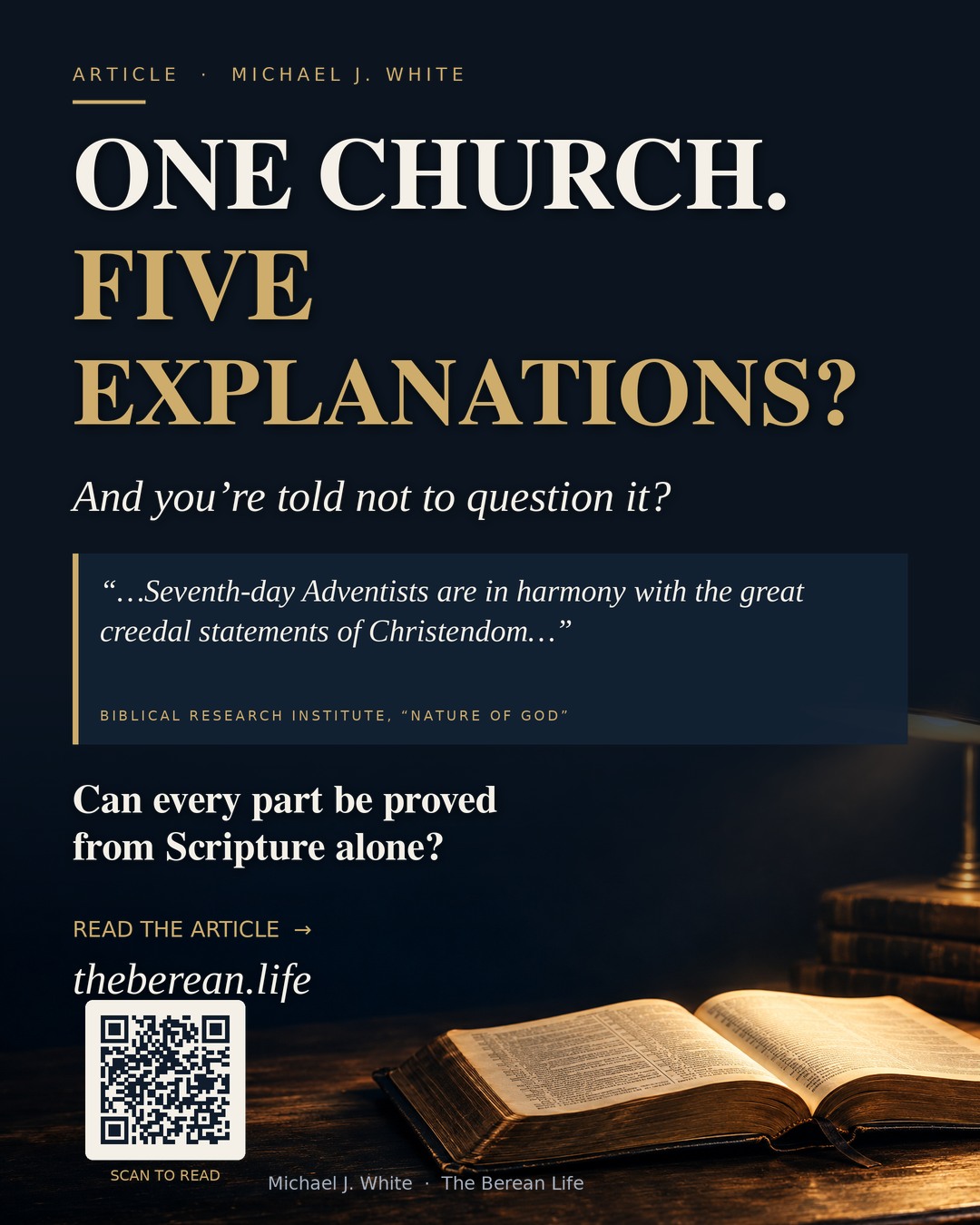
The Adventist Church says it follows Scripture. Its own research institute says it agrees with historic creeds. So what, exactly, is the official doctrine of God, and can every part of it be proved from the Bible alone?
I want a clear answer from my Trinitarian brothers and sisters. Not philosophy. Not tradition. Not a creed. Scripture, and Scripture alone.
First, read what the church itself says
The following is the full statement “Nature of God” from the Seventh-day Adventist Biblical Research Institute website:
Nature of God. A reading of the above statements will show that with respect to their doctrine of God Seventh-day Adventists are in harmony with the great creedal statements of Christendom, including the Apostles’ Creed, Nicea (325), and the additional definition of faith concerning the Holy Spirit as reached in Constantinople (381). However, such was not always the case. Many early Adventists came from churches holding to what is described as a semi-Arian position on the nature of Christ, making it the predominant view for almost a half-century. Shortly before the close of the 19th century, however, as theological development took place, and with the encouragement of Ellen White, the church moved to a full trinitarian position. Other classical teachings that came to be designated as heresies, such as forms of monarchism and modalism, have not troubled Adventists.
Source: Adventist Biblical Research Institute, Seventh-day Adventists: the official doctrine.
Read that carefully.
The church’s own research institute explicitly connects Adventist teaching with the historic creeds of Christendom, including Nicaea (325) and Constantinople (381).
Yet I regularly hear Adventists insist that their Trinity is different from the Catholic Trinity.
Different in what precise way? Where is that difference defined, and where is every part of that definition established in Scripture?
That is not an attack. It is a reasonable question about a doctrine concerning the identity of God.
Here is the problem we need to face
Christianity has developed numerous competing explanations of the Trinity. Adventist discussions likewise contain different explanations of what it means for God to be one, and for the Father, Son, and Holy Spirit to be three.
I have encountered at least five distinct ways the subject is explained in Adventist discussions. I am not claiming that the church officially recognizes five separate Trinity doctrines. I am asking why explanations that can make substantially different claims are so often treated as though they are interchangeable.
Consider the actual differences:
- One Being, three Persons. God is one divine Being who exists eternally as three distinct Persons.
- Three distinct divine Persons united as one Godhead. The emphasis is on the three Persons and their perfect unity.
- Social Trinitarianism. The unity of God is explained substantially through the eternal relationship, love, and communion of the three Persons.
- Explanations that blur Being and Person. These use the same words but can leave the relationship between the one God and the three Persons unclear.
- Explanations criticised as tritheistic. These are understood by critics as presenting three divine Beings rather than one God, even when their proponents insist on monotheism.
These are not five interchangeable definitions. Nor are they five equally established official Adventist positions. They illustrate why we must ask what the church actually means, rather than assume that everyone using the word Trinity means precisely the same thing.
The differences matter. Saying there is one Being and three Persons is not the same proposition as saying there are three divine Beings united in purpose. Calling three Beings one God because they agree does not, by itself, establish that they constitute one Being.
If these explanations mean the same thing, demonstrate how. If they contradict one another, which one is true?
And if Christianity has around 17 distinguishable formulations or models, as I have encountered claimed, where is the documented comparison that identifies them and explains their differences? I want that question answered with evidence, not simply another label.
Now apply the same standard to Scripture
Adventist Fundamental Belief No. 2 states:
There is one God: Father, Son, and Holy Spirit, a unity of three coeternal Persons.
Source: Official Adventist Fundamental Beliefs, No. 2.
I have read the statement. But what does it mean in precise terms?
- Where does Scripture define the word Being in this formulation?
- Where does Scripture define Person in this formulation?
- Where does Scripture establish the exact relationship between the one God and the three coeternal Persons?
- Where does Scripture establish every essential claim in the specific explanation the church intends its members to believe?
Please do not merely give me Matthew 28:19 or 2 Corinthians 13:14 and assume the entire theological formulation has thereby been proved. Those passages must be examined, but mentioning the Father, Son, and Holy Spirit is not the same as demonstrating every proposition contained in a particular theological definition.
Show the claim. Show the text. Explain how the text proves the claim.
That is how we should examine every doctrine.
What about the church’s own history?
The BRI acknowledges that the early Adventist movement did not always hold its present Trinitarian position. It describes a substantial development toward that position during the late nineteenth century.
That fact alone does not prove the modern position false. But it raises an important question:
What specific biblical evidence established that the later understanding was correct and the earlier understanding was mistaken?
Can that evidence be demonstrated from Scripture itself, without appealing to the authority of a later creed, a theologian’s philosophical explanation, or the fact that the church eventually adopted the position?
If the doctrine is biblical, surely we should be able to examine the biblical case.
The question I want every Adventist to consider
We are told to test doctrine by Scripture. We are told not to accept human traditions in place of God’s Word.
So why is asking for a precise definition of the Trinity so often met with appeals to mystery, accusations about motives, or arguments over which theological label someone should accept?
I accept that God is beyond our full comprehension. But that does not mean every statement made about Him is beyond examination.
There is a difference between not comprehending everything about God and being unable to demonstrate what we claim the Bible teaches about Him.
And there is a difference between believing a mystery revealed in Scripture and using the word mystery to avoid answering a question about a doctrine’s precise claims.
If Scripture is our only creed, let Scripture settle the question.
Tell me exactly which understanding of the Trinity is correct. Identify every essential claim. Then provide the biblical texts that establish each claim, explaining them in context.
Do not ask me to accept a proposition simply because a church, a theologian, or a historic council says it is correct.
And please apply that same standard when examining my understanding of the Father and His Son. If I am wrong, correct me from Scripture. But if you cannot explain your own doctrine clearly, how can you be certain that you are correcting mine?
I am not asking you to agree with me. I am asking you to demonstrate what you believe.
The identity of God is too important for contradictory explanations, undefined terminology, and appeals to authority to settle the matter.
Truth does not need protection from honest questions.
My question to Trinitarian Adventists
What is the exact doctrine you believe, and can you prove every essential part of it from Scripture, and Scripture alone?
I welcome a biblical answer.
A note: why am I asking these questions?
When a very prominent figure in the General Conference of Seventh-day Adventists tells you that your books will destroy the church’s reputation because they expose the contradictions, omissions, and historical changes that he himself cannot even answer questions about, it raises a disturbing question: is exposing a problem the real problem, or is the problem itself the problem? If defending the institution’s reputation becomes more important than defending Scripture, there is a very serious disconnect.
If I am pointing out contradictions I discover in the church’s own published statements, asking for clarification, and requesting Scripture to support what its leaders publicly teach, how does that make me the enemy? Since when did asking for biblical evidence become a threat to God’s church?
Imagine witnessing a serious crime and being called to testify. Instead of addressing the crime, the prosecutor turns against you and declares that your testimony will destroy the reputation of the town. Suddenly the person exposing the wrong becomes the problem, while the wrong itself receives less attention.
Would that make the testimony false? Would silencing the witness undo what happened? Of course not. And neither does attacking the person who exposes a contradiction make the contradiction disappear.
If my books contain errors, show me the errors. They exist precisely because I never received a single answer to any of my questions. If my conclusions are wrong, correct them from Scripture. If the church statements are clear and consistent, explain them.
But please do not confuse exposing a problem with creating it.
Truth has nothing to fear from honest examination. And if a belief cannot withstand questions, perhaps it is time to examine the belief rather than attack the person asking them.
Michael J. White
The Berean Life